

Strategic Plan
In 2023, Missoula Public Library adopted a strategic plan that lays out what we said we would do, how we would measure progress, and how we are putting our commitments into action. This page offers an overview of that work and shows how our mission, values, and priorities continue to guide decisions across the organization.
View the original strategic plan
Our Mission
Spark Curiosity. Make Connections. Thrive Together.
Our Vision
Missoula County is vibrant, creative, and healthy. MPL gives compassionate, inclusive service to all and is the first place everyone goes to learn, engage, innovate, and have fun.
Our Values
Access
- We put people at the heart of all we do
- We support discovery and lifelong learning
- We commit to equitable access for all
Innovation
- We anticipate changes and challenges and respond with agility
- We celebrate the creativity of staff and patrons
- We consider sustainable practices as core to our identity
Integrity
- We act in ways that foster trust and confidence
- We are accountable to the community and to each other
- We abide by the ethical principles that define modern librarianship
Kindness
- We promote the well-being of staff and the community
- We treat all people with compassion
- We seek to understand the needs of the people we serve
Reflection
- We reflect the diversity of our community
- We actively listen to our community
- We are intentional in our actions and decisions
Our Strategic Priorities
Community members express that they experience isolation, siloing of resources, the need for connection, and lack of time to visit the Library. Missoula Public Library will extend the Library’s reach to underserved and geographically isolated populations by leveraging its branch network, developing new community resources, and expanding on the downtown flagship’s “all under one roof”1 model.
Goal: Intentional services to priority communities2 through outreach
- Assess greatest community needs in context of projected Library capacity
- Determine and assign funding sources/uses for new outreach initiatives
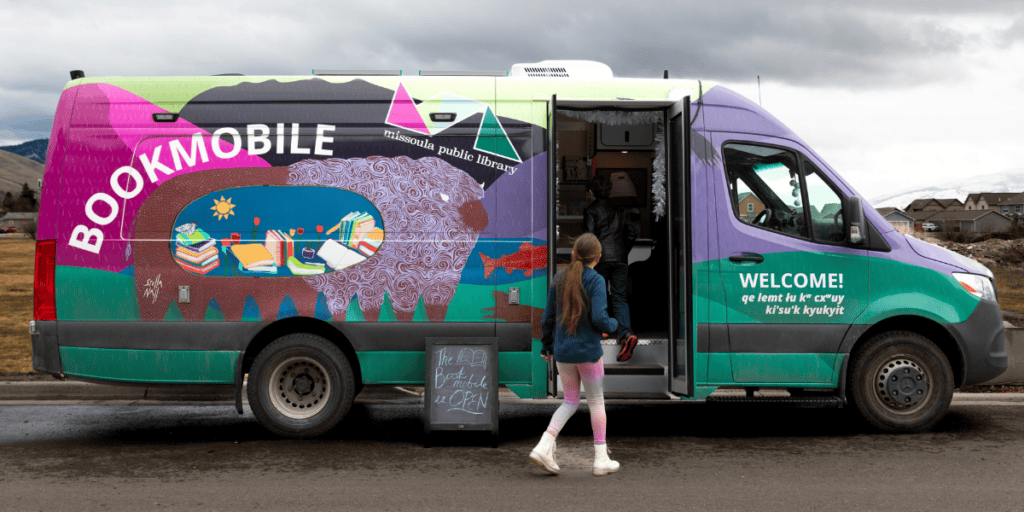
Unveil first resource for expanded cross-town or rural Library access and launch first program/service for underserved population (e.g. Bookmobile)
Goal: More welcoming spaces for Indigenous community members, teens, refugees/immigrants, and people with disabilities
- Co-create with priority communities to determine what modifications are needed and what additions would be helpful.
- Expand access by bringing elements of MPL to locations outside of the libraries through outreach (e.g. activities at Kyiyo Pow Wow) and passive programs (e.g. mini libraries at laundromats).
- Allocate more resources to branches for improvements, programs, collections, and signage.
- Provide staff training opportunities with an emphasis on equity, diversity, and inclusion and apply concepts to work tasks.
Goal: Diversified collaborations and increased representation organization-wide
- Form Community Engagement Department to define collaboration options, develop outreach plan, and build and strengthen community relationships
- Leverage the AUOR model and expertise of Partners to strengthen and expand relationships with priority communities and cultural organizations.
- Form Community DEI3 Advisory committee based on models established by local organizations like Missoula Food Bank and Community Center.
Goal: Community-centered programming
- Develop mission-driven programs that spark curiosity; connect people to ideas, information, and each other; and contribute to a thriving community.
- Provide civic-oriented opportunities to participate in activities related to current affairs, community partnerships, and County-wide initiatives.
- Create better evaluation tools to understand the impact of programming and gauge MPL’s response to the needs of priority communities.
Adapting to Missoula Public Library’s new base of operations presents unique challenges for the Library. These challenges are compounded by the growth in collection sharing obligations MPL experiences as a leader in the Montana Library Collective and Montana Shared Catalog. The Library will continue its commitment to meeting customer service expectations, improving collection access, maintaining efficiency, and leading in statewide projects.
Goal: Easier access to materials and services
- Continue to promote accessibility to resources via the website, video tutorials, signage, etc.
- Reassess points of service based on user experience design4.
- Provide statewide leadership for and collaborate with the Montana Shared Catalog and Montana State Library to improve systems, such as courier routes, catalog records, reports, and batch updates.
- Develop practices for effective merchandizing to formalize how materials are shelved and displayed.
Goal: More diverse, relevant, and current collections
- Use vendor resources to enhance selection and provide collection analysis.
- Implement updated Collection Development policies.
- Abide by the American Library Association standards for Intellectual Freedom5.
Goal: Increased accuracy and speed in circulation functions
- Evaluate procedures using the Lean assessment6 to determine if and how many unnecessary steps are being taken in each process (e.g. PCI).
- Maintain automation tools so they work effectively.
- Recruit and train volunteers to support daily tasks, and reevaluate volunteer policy for best practices.
Goal: Renewed commitment to providing patrons accurate information
- Keep up with emerging trends in patron-centered services (e.g. database subscriptions).
- Provide trust-worthy sources of authoritative information.
- Encourage independence through patron education and supporting information literacy
Goal: Improved response to emerging technologies, service automation, and privacy needs
- Adopt a future forward and curious approach to anticipating trends
- Create 3-5 year technology plan
- Revaluate IT budget
Goal: Staff engagement
- Leverage staff talents, interests, and skills in innovation and improvement of library programs and services.
- Cultivate highly trained, motivated, and engaged teams by developing innovative resources and support, such as training plans, dedicated time for professional development, etc.
- Develop and strengthen internal communications and information sharing.
Our community faces major challenges related to the intersection of ecological vulnerability, economic viability, and social equity. Missoula Public Library aims to create a holistic model of sustainability through resources and programs that address these resiliency issues.
Goal: Certification in the Sustainable Libraries Initiative Program7
- Provide training for MPL leaders and staff in operational sustainability, whole-systems thinking8, and the SLI’s “triple bottom line” concept (environmentally sound + economically feasible + socially equitable).
- Establish a Sustainability Team, drawn from a cross-section of the Library’s workforce and leadership, that will field recommendations and monitor the Library’s sustainable operations goals.
- Assess MPL in the context of the SLI’s certification criteria; begin and follow through on the certification process.
Goal: Streamlined health/wellness resources, library-based social services, and economic sustainability tools
- Develop a programming matrix that guides the Library to intentionally and consistently offer programs related to: (a) economic stability; (b) health and wellness; and (c) diversity, equity, and inclusion.
- Establish one or two new collaborations with other community groups in each of these areas: health/wellness, economic stability, social equity.
- Work with staff to explore new and innovative ways to address workplace wellness, work-life balance, personal growth, and belonging.
Goal: An MPL action plan for renewable energy use and energy efficiency in conjunction with community-wide carbon neutrality goals
- Assess the downtown facility’s current energy performance, and compare to engineers’ projections, 301 Main, and/or industry standards (2023).
- Work with City’s Climate Action office, County’s Sustainability Program, Climate Ready Missoula, and Climate Smart Missoula to determine MPL’s role in broader community’s net zero emissions goals (2023-2024).
- Identify short/long term goals for reducing fossil fuel reliance and increasing efficiency; finalize, publish, and launch an MPL five-, ten-, and twenty-five year carbon neutrality plan (2025).
Goal: Expert management of downtown Library’s environmental systems, architectural engineering, and design elements
- Launch and complete effort to re-commission building’s mechanical systems with engineering firm Morrison-Maierle.
- Partner more closely with County Facilities with an emphasis on achieving building efficiency and long-term sustainability.
- Increase training in various systems (HVAC, lighting, security, information technology) among relevant management and staff leadership.
- Explore the concept of a Facilities Advisory Team that draws from expertise internally and externally and can field issues related building maintenance, property concerns, and design integrity.
- “All under one roof” (AUOR) is the moniker for the site-sharing partnerships between MPL and Families First, MCAT, spectrUM, and the UM Living Lab. AUOR is a unique collaborative approach to lifelong learning services inspired by the Swedish kulturhuset (culture house) model of librarianship.
- MPL’s priority communities include Indigenous individuals, teens, refugees and immigrants, and people with disabilities.
- DEI: diversity, equity, and inclusion
- User experience (UX) design is an empathetic process for creating a successful product or service through (a) conducting research, (b) defining problems, (c) brainstorming ideas, (d) developing a prototype, and (e) testing iterations.
- American Library Association standards for Intellectual Freedom and the “Library Bill of Rights” can be found at: https://www.ala.org/advocacy/intfreedom/librarybill
- Lean assessment: a management tool that (a) identifies value, (b) maps value stream, (c) develops flow, (d) establishes pull, (e) continuously improves.
- Sustainable Libraries Initiative: https://sustainablelibrariesinitiative.org/
- Whole-systems thinking is a method for understanding how elements, facets, and surroundings are connected and influence each other.
Update for FY2025
Missoula Public Library (MPL) is a hub of community life, connecting people to information, culture, opportunity, and one another. As Missoula grows and diversifies, the Library continues to evolve as a welcoming, innovative, and trusted public institution.
We affirm MPL’s value as:
- A connector, reducing isolation and bringing people and resources together
- An access point, removing barriers to information, culture, and services
- A community partner, working alongside organizations and residents to meet shared goals
- A forward-looking institution, adapting to changing needs, technologies, and environmental realities
Progress at a Glance
This update shows what we have delivered so far, using clear numbers and plain examples. It also shows the everyday value the library returns to the community, including time saved and costs avoided. You can also view progress on each strategic priority below.
Bookmobile Access
- 4,327 people served
onboard the Bookmobile - 7,494 items checked out
- 98 offsite programs, expanding access beyond the building

Programs Delivered
- 1,320 total programs.
- 27,239 total program
attendance - 3,750 tech instruction attendance for help with devices and computer basics.

Partnership Highlights
- Big Sky DocShop, Chickadee Community
Services, Jeanette Rankin Peace Center - Bookmobile stops: Meadowlark, Travois Villages, Food Bank

Digital & Info Access
- 22,398 database uses, supporting research, homework, and job search
- $50,000+ invested each year in digital collections
Efficient Use of Resources
- Updated self-checkout & automatic renewal make visits faster
- 2,400 volunteer hours support daily operations

Welcoming Spaces
- Teen Space relocated & designed with youth input
- Indigenous-designed elements added to youth areas
- Salish language signs added

Donor Support
- Foundation support
funded initiatives, including the Bookmobile (~$300,000) - Friends of the Library gave $18,182 to support programs and staff

Workforce Investment
- 42% of staff certified by the Montana State Library
- An additional 28% of staff in progress toward certification, strengthening service quality statewide

Collection Sharing
- MPL leads Montana Shared Catalog work, sending out 130,000 items in FY25 and receiving 100,000.
Building & Sustainability
- Energy intensity improved from 83 (2023) to 70 (2025)
- Energy performance 17%
better for comparable
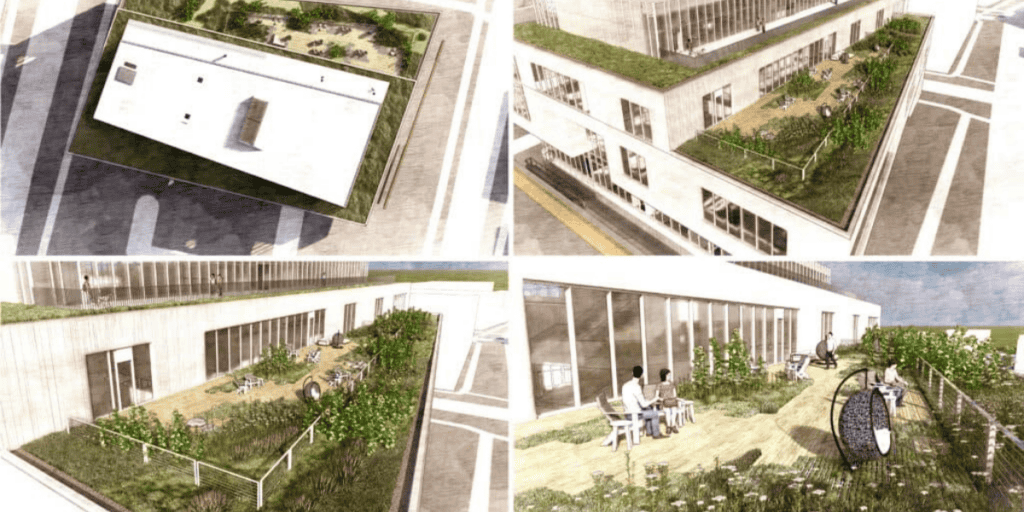
properties - Living Roof coming soon!
What This Saves the Community
- Time: Faster access through self-service, digital tools, and outreach, with fewer waits and fewer repeat trips.
- Travel: Services that come to people, reducing miles driven and transportation costs.
- Household costs: Free books, streaming and digital media, learning tools, programs, and technology that replace out-of-pocket spending.
- Public dollars: More service from the same investment through shared infrastructure, volunteers, automation, and partnerships.
- Community systems: A trusted hub that helps people connect, find information, and get support, easing pressure on other services.
Together, these add up to clear public value: high use, broad community reach, efficient service delivery, and lasting benefit for Missoula.
Progress by strategic Priority
Intentional Outreach to Priority Communities
MPL has taken meaningful steps to expand access beyond our walls. The launch of the Bookmobile in September 2024 marked a major milestone, bringing library services directly to neighborhoods, rural areas, and residents facing barriers to visiting a library location. In 2025 alone, the Bookmobile recorded 4,427 visits and 7,494 circulations, including service through the Home Library program.
Philanthropic investment has supported this work, along with targeted initiatives such as Indigenous-centered programming, inclusive internships, teen space redesign, and culturally meaningful signage. Moving forward, MPL will more intentionally align outreach efforts with assessed community needs and available capacity, ensuring sustainable growth and impact.
Welcoming and Responsive Spaces
MPL continues to improve its physical and programmatic spaces so all community members feel seen, safe, and supported. Recent efforts include:
- Relocation and redesign of the Teen Space, informed by youth voices and community partners
- Indigenous-designed elements integrated into youth play spaces, created in collaboration with Indigenous cultural experts
- Initial accessibility improvements informed by a professional assessment, with additional enhancements planned
- Through offsite programming, branch investments, and passive services such as mini-libraries, MPL is extending the spirit and resources of the Library throughout the community.
Collaboration and Representation
The creation of the Community Engagement Department represents a structural commitment to partnership, outreach, and representation. Guided by a formal partnership framework, MPL works with cultural organizations, service providers, and community leaders to deliver shared programming and strengthen trust.
The Library’s All Under One Roof model continues to foster vibrant collaborations, resulting in free cultural events, civic dialogue, and opportunities for connection. Establishing a Community DEI Advisory Committee remains a future priority to further ground this work in community guidance.
Community-Centered Programming
In FY25, MPL delivered 1,320 programs, spanning lifelong learning, culture, civic engagement, and creative expression. The Library serves as a neutral and welcoming space for public dialogue, voter engagement, and community planning processes.
As programming continues to grow, MPL will refine evaluation tools to better understand impact, particularly priority communities, and ensure programs remain mission-driven and responsive.
Easier Access to Materials & Services
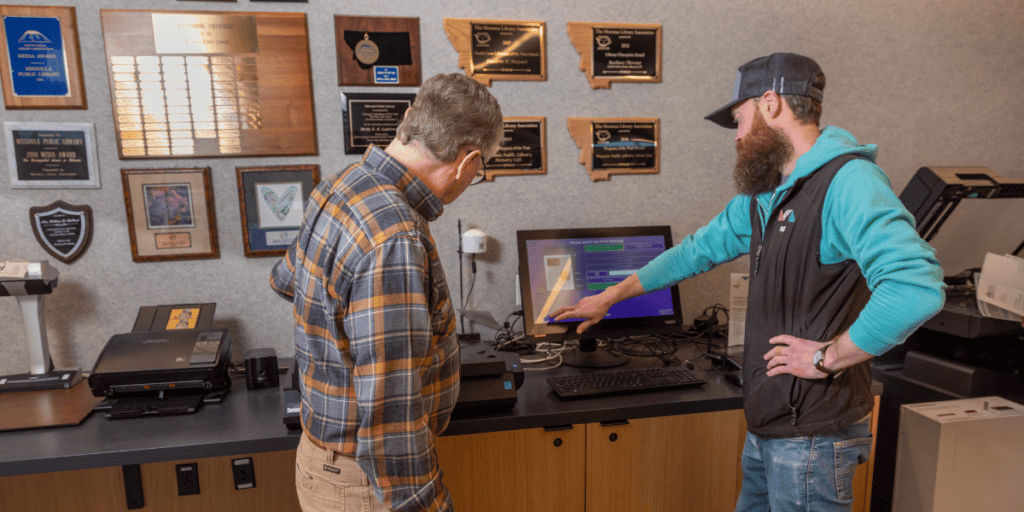
MPL continues to streamline access through thoughtful space design, improved visibility of service points, and investments in self-service technologies. Enhancements to automation, self-checkout, lockers, and auto-renewal have increased convenience while freeing staff time for high-impact service.
As a leader within the Montana Shared Catalog, MPL provides statewide leadership in resource sharing, catalog quality, and courier coordination—benefiting libraries and patrons across Montana.
Strong, Relevant Collections
The Library invests heavily in current, high-demand materials, including digital collections, while adhering firmly to American Library Association standards for intellectual freedom. Updated collection development policies and shared selection practices ensure balanced, inclusive, and trustworthy collections.
Efficient & Accurate Operations
MPL has modernized circulation workflows through automation, equipment upgrades, and expanded volunteer support. Ongoing evaluation of procedures will further improve efficiency and accuracy as service demands grow.
Information You Can Trust
From expert-led programs to authoritative databases and local digital news preservation, MPL remains a trusted source of accurate information. Through makerspace training, information literacy programs, and self-directed services, the Library empowers patrons to navigate information independently and confidently.
Technology & Privacy
Guided by a five-year technology plan, MPL maintains current, energy-conscious systems and prepares for emerging trends. This plan will be revisited to ensure continued alignment with community needs, privacy expectations, and fiscal responsibility.
Staff Engagement & Excellence
MPL’s staff are its greatest asset. Investments in professional development, certification, and internal communication have cultivated a skilled, motivated workforce. Collaborative committees, modern communication tools, and dedicated training time support innovation, safety, and shared leadership across the organization.
Environmental Performance and Facilities Stewardship
The downtown library’s energy use is closely monitored and has improved through system adjustments and recommissioning efforts. While performance does not yet meet original design targets, recent gains demonstrate progress and opportunity.
The addition of a Facilities Administrator strengthens MPL’s capacity to manage complex building systems, increase staff training, and respond proactively to maintenance and efficiency challenges.
Looking Ahead
As part of the SLI certification process, MPL will:
- Establish cross-departmental sustainability leadership
- Define clear goals for energy efficiency and emissions reduction
- Strengthen partnerships with local climate and sustainability organizations
- Develop long-term plans aligned with community-wide carbon neutrality efforts
Community and Workplace Wellbeing
MPL supports community resilience through programs addressing health, wellness, economic stability, and equity. Internally, staff engagement, safety, and wellbeing are supported through dedicated committees, collaborative labor-management practices, and opportunities for professional growth and connection.
Moving Forward
We’re active, adaptive, and deeply connected to our community. We’ve made significant progress in expanding access, strengthening partnerships, and modernizing services. At the same time, we acknowledge opportunities for more intentional assessment, evaluation, and long-term planning.
Grounded in community values and guided by public trust, Missoula Public Library will continue to learn, collaborate, and lead, ensuring that it remains an essential and inclusive resource for all.