

Making Connections
Level One: The Place of the Little Bull Trout
At the intersection of Adams and Main, just a few feet from the northwest corner of Missoula Public Library’s flagship, stands the first wayfinding kiosk and sidewalk medallion of a Missoula Downtown Partnership public history project called the Legacy Trail. The kiosk includes a lithograph of an 1853 painting by John Mix Stanley (featured here) depicting Indigenous characters at the mouth of Hellgate Canyon, near the present-day library block. For millennia, this location was known to the Salish as the “the Place of the Bull Trout,” an important seasonal gathering point and natural resource.
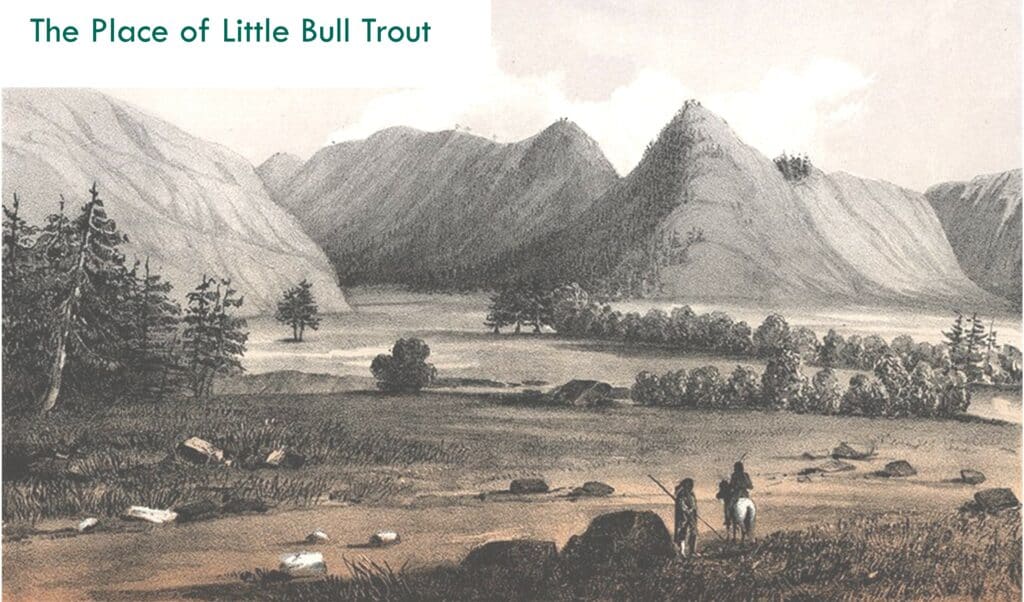
Eventually, settlers acquired the ancestral homeland of the Bitterroot Salish and Kalispel Peoples through dispossession and systematic attempts to destroy Indigenous culture. By acknowledging Montana’s colonial past, our community can begin a process of reconciliation. MPL is committed to providing a welcoming space for Indigenous People, expanding Indigenous engagement and access to library programs and services, and celebrating Indigenous culture through programming, literature, art, collections, and Salish language signage.
-
More Level 1:
- Indigenous Culture
- Library Highlights
- Green Library
Making Connections
Level Two: The Charley Harper Wall
The wildlife mural behind the level 2 Reading Hive is an intricate design by the modernist artist Charley Harper called “Beguiled by the Wild.” Harper produced a book by the same name, and his artwork can be found in mid-20th century magazines, The Golden Book of Biology, a Betty Crocker cookbook, and a popular series of national park posters. He grew up on a farm, attended the Art Academy of Cincinnati in the 1940s, and became a commercial illustrator and teacher. Harper was influenced by Cubism, Einstein’s physics, and the early conservation movement, and called his style “minimal realism.”
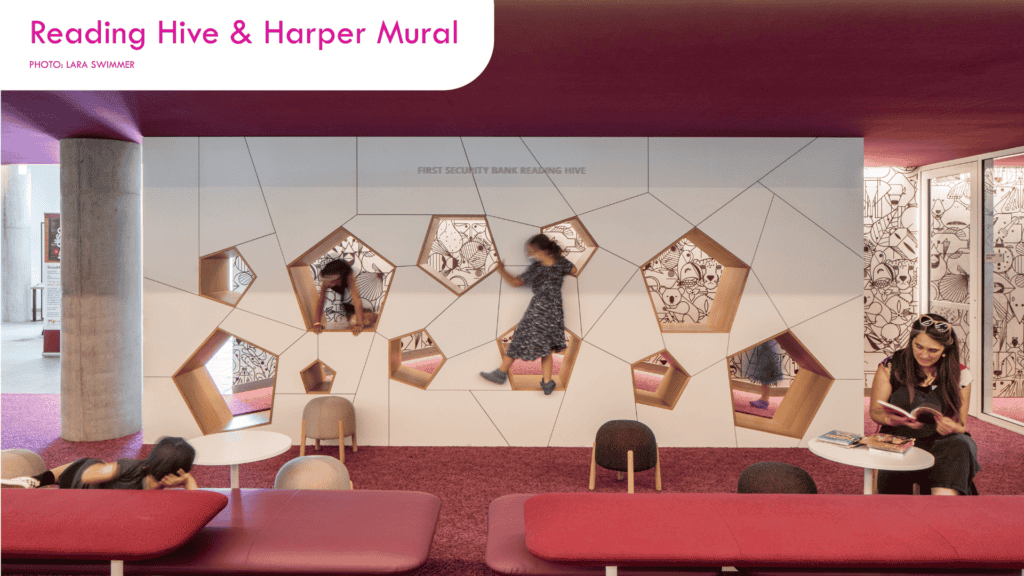
Charley Harper described his approach to illustration this way:
“I regard the picture as an ecosystem in which all the elements are interrelated, interdependent, perfectly balanced, without trimming or unutilized parts. Herein lies the lure of painting: in a world of chaos, the picture is one small rectangle in which the artist can create an ordered universe.” (Frame House Gallery, 1977)
-
More Level 2:
- Indigenous Culture
- Library Highlights
- Green Library
Making Connections
Level Three: The Ellingson Conference Room
The Ellingson Conference Room in the southwest corner of level 3 is named for Mae Nan Ellingson, former Missoula Public Library Foundation board member, and co-chair of the All Under One Roof Capital Campaign. After graduating from the University of Montana Law School, Ellingson’s work for the Missoula City Attorney’s office was pivotal in securing much of our community’s iconic green spaces, like a riverfront trail system and the Mount Sentinel easement.
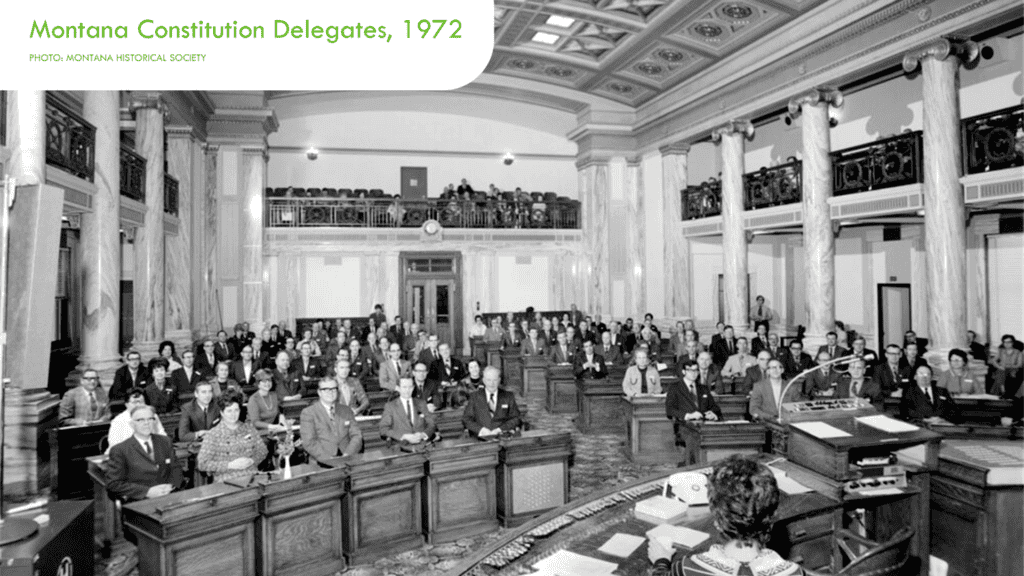
In 1972, Ellingson was a delegate to the Montana Constitutional Convention (and at age 24, the youngest delegate), an experience which inspired her future law career and work on behalf of government efficiencies, environmental protections, and equal rights. Montana’s 1972 Constitution, once called a “model document” by Time, is unique for its forward-looking approach to ecological issues. Article II establishes an “inalienable right to a clean and healthful environment,” and the Constitution’s eloquent preamble, coauthored by Mae Nan Ellingson and Bob Campbell, applies such “blessings of liberty” to both “this and future generations.” An artist’s rendition of the Preamble can be viewed inside the Ellingson Conference Room.
-
More Level 3:
- Indigenous Culture
- Library Highlights
- Green Library
Making Connections
Level Four: The Monumental Staircase
Level 4 provides an opportunity to highlight Missoula Public Library’s defining architectural feature: the monumental staircase. While the staircase literally connects visitors to all areas of the building and serves as an important light shaft throughout the library’s core — this corresponding five-story sculptural wall offers a visual metaphor for the variety of connections MPL facilitates in our community and beyond.
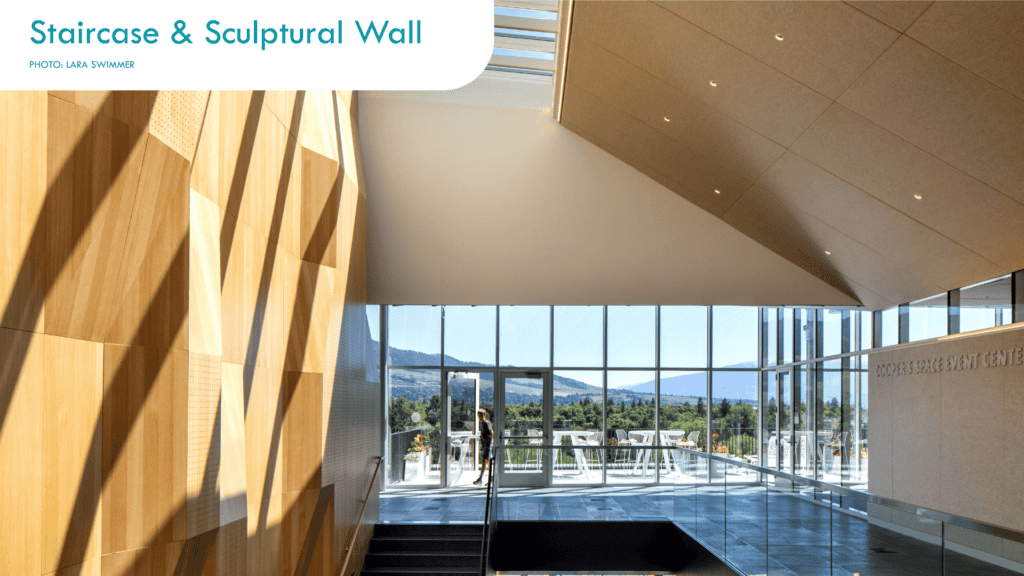
White oak panels bring warmth to the building’s “civic modernism,” while some are drilled with a peg board effect as part of the acoustic design. The full schematic of the wall is based on a giant topographical map of western Montana, stretching from the Bitterroot and Sapphire mountains south of Missoula (at level 0’s parking garage) to Glacier National Park’s gateway communities to the north (at level 4’s atrium). Changing elevations of the map are “pixelated” and abstracted until they cohere as one grand-scale 3D installation. The sculptural wall invokes Missoula Public Library’s role as an important regional exchange for books, information and ideas, and the best practices of public librarianship.
-
More Level 4:
- Indigenous Culture
- Library Highlights
- Green Library